
Introduction
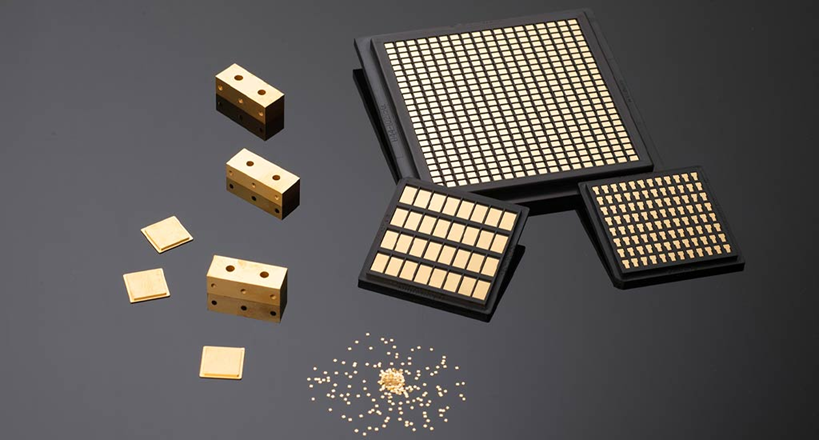
Tungsten heat sinks occupy a narrow but consequential position in the thermal management landscape. Most heat sink applications are served adequately by aluminium or copper, materials that are abundant, easy to process, and thermally capable across the broad middle of the performance spectrum. But at the extremes, where operating temperatures are severe, thermal loads are intense, and dimensional stability under cycling conditions is non-negotiable, the material properties of tungsten produce outcomes that no common alternative can replicate. Understanding why requires examining what tungsten actually offers as a thermal management material and where those properties translate into performance advantages.
Why Tungsten as a Heat Sink Material
Tungsten’s thermal management credentials begin with a set of material properties that are, in combination, unique among engineering metals. Its melting point of 3,422 degrees Celsius is the highest of any metal. Its density of 19.3 grams per cubic centimetre is nearly twice that of lead. And its coefficient of thermal expansion, at approximately 4.5 parts per million per degree Celsius, is closely matched to the thermal expansion behaviour of semiconductor materials including silicon and gallium arsenide.
That last property is what makes tungsten heat sinks particularly valuable in electronics and power device applications. When a heat sink material expands and contracts at a significantly different rate than the device it is cooling, the resulting thermomechanical stress accumulates over thermal cycles, degrading bond integrity and ultimately causing device failure. Tungsten’s closely matched coefficient of thermal expansion reduces that stress substantially, extending operational lifetime under cyclic thermal loading.
Thermal conductivity for pure tungsten is approximately 173 watts per metre-kelvin at room temperature, lower than copper at 400 watts per metre-kelvin but significantly higher than most structural metals and ceramics. Where both high conductivity and low expansion are needed, tungsten-copper composite materials extend the performance envelope further.
Tungsten-Copper Composites in Thermal Management
For applications demanding higher thermal conductivity alongside controlled expansion behaviour, tungsten-copper composites offer a tailored solution. Produced by infiltrating a porous tungsten skeleton with copper, the composite properties can be adjusted by varying the tungsten-to-copper ratio:
- Higher tungsten content reduces thermal expansion and increases density, at the cost of lower conductivity
- Higher copper content raises thermal conductivity and reduces density, with a corresponding increase in thermal expansion coefficient
- Common compositions range from 70 to 90 percent tungsten by weight, with thermal conductivities between 180 and 250 watts per metre-kelvin and expansion coefficients between 6 and 9 parts per million per degree Celsius
This tunability makes tungsten heat sink composites well suited to power electronics packaging, microwave device cooling, and semiconductor substrate applications.
Manufacturing Processes for Tungsten Heat Sinks
Tungsten’s high melting point and hardness preclude conventional casting and limit standard machining approaches. Powder metallurgy is the dominant production method, with tungsten powder compacted under high pressure and sintered at temperatures between 2,000 and 2,500 degrees Celsius. Sintered blanks are subsequently machined to final geometry using specialised tooling. Metal injection moulding has extended the geometric complexity achievable in tungsten heat sink components, enabling near-net-shape production of intricate cooling geometries that would require prohibitive machining time from sintered blanks.
Singapore’s precision manufacturing sector has developed capability in both production routes for tungsten heat sinks, supported by the country’s concentration of semiconductor and advanced electronics manufacturing activity.
Thermal Performance in Demanding Applications
The performance advantages of tungsten heat sinks are most clearly demonstrated where conventional materials fail. Power electronics and RF device cooling represent the most significant current application domain. Wide-bandgap semiconductors operating at high power densities generate localised thermal loads that exceed the capacity of standard heat sink materials without inducing thermomechanical damage. Tungsten heat sinks maintain bond integrity and device performance under conditions that would degrade copper or aluminium solutions considerably sooner.
Aerospace and defence applications extend to directed energy systems, radar transmitters, and satellite power conditioning equipment. Semiconductor fabrication equipment relies on tungsten heat sink components within plasma processing chambers and ion implantation systems, where exposure to reactive process chemistries, high temperatures, and vacuum conditions simultaneously eliminates most competing materials.
Design and Integration Considerations
Integrating tungsten heat sinks into a thermal management system requires attention to material-specific factors. The high density of tungsten adds mass to assemblies where weight budgets are constrained. Bonding tungsten to dissimilar materials requires interface engineering that accounts for residual thermal stress. Surface preparation before bonding or metallisation is critical, as tungsten’s surface oxide layer must be managed carefully to ensure reliable metallurgical bonds.
Conclusion
Tungsten heat sinks are the considered choice for a specific class of problems where operating temperature, thermomechanical stress, and dimensional stability requirements collectively eliminate the alternatives. In those applications, the material properties of tungsten deliver thermal performance and operational reliability that justify both the material cost and the manufacturing complexity involved. For engineers working at the boundaries of what conventional thermal management materials can sustain, tungsten heat sinks represent a well-characterised and proven solution.